


TL;DR: Why do AI applications fail even with well-crafted prompts? Often, the real problem is a lack of context. The Context Engineering Handbook explores practical techniques for grounding AI with relevant information, helping developers build more accurate, reliable, and production-ready apps.
As AI applications move from prototypes to production, many teams discover that better prompts alone don’t guarantee better results. Instead, the missing piece is often context.
An AI assistant can follow instructions perfectly and still fail if it lacks relevant, up-to-date information. That is why context engineering, the practice of providing models with the right information at the right time, has become a critical part of building reliable AI apps.
We’re excited to introduce the Context Engineering Handbook, a practical guide that explores how developers can build AI applications that are more accurate, grounded, cost-efficient, and reliable.
Why better context often matters more than better prompts
Prompting remains important, but production AI systems also depend on the quality, relevance, and structure of the information available to the model.
For example, consider a customer support assistant answering questions about a company’s refund policy. Even the best prompt cannot compensate for outdated or missing policy information. The model first needs access to the latest documentation before it can provide a reliable answer.
This is where context engineering makes a difference by retrieving, organizing, and delivering the right information at the right time.
Instead of focusing only on instructions, it focuses on the information available to the model when it generates a response. That information may include:
- Relevant documents and knowledge sources,
- Examples that guide response quality,
- Business rules and operational constraints,
- User-specific information,
- Tool outputs and system state,
- Historical conversation context,
- Conversation summarization,
- Relevance filtering,
- Context compression, and
- Token budget management.
The goal is simple: provide the information that helps the model complete the task successfully while filtering out unnecessary noise.
What is context engineering?
At its core, context engineering is the practice of designing, assembling, managing, retrieving, and delivering the information an AI model needs to complete a task reliably.
Prompt engineering focuses on how you instruct the model. Context engineering focuses on what information is available to the model when it generates a response.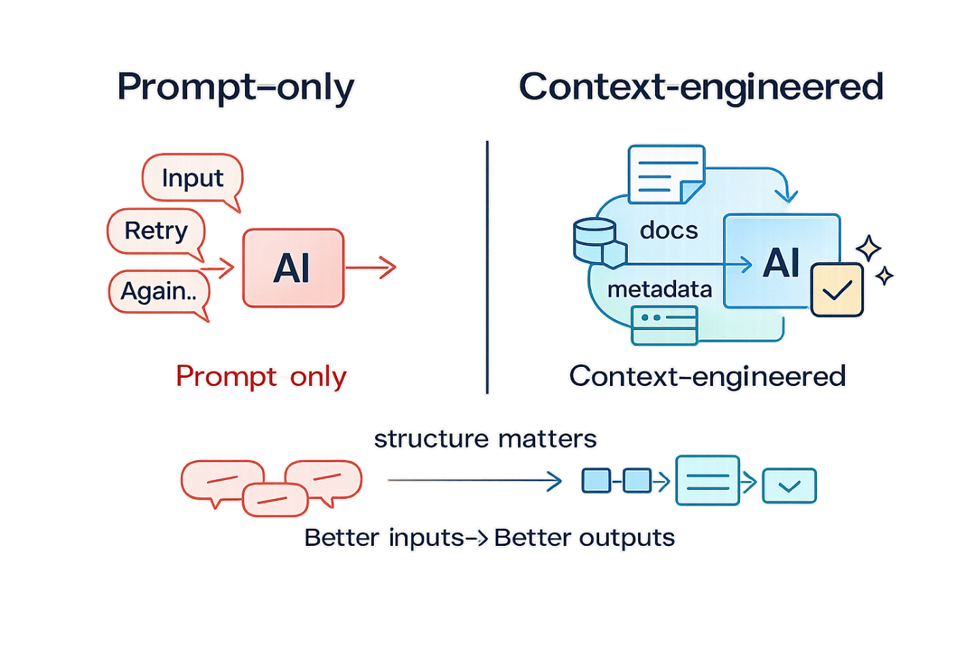
In practice, this means deciding:
- Which information should be included,
- Which information should be excluded,
- How information should be structured,
- When information should be retrieved, and
- How context should evolve during execution.
As AI systems become more sophisticated, these decisions can have as much impact on output quality as prompt wording.
Here’s the context engineering pipeline:
User request
↓
Retrieve relevant information
↓
Filter irrelevant content
↓
Rank/prioritize context
↓
Add memory + tools + constraints
↓
Assemble model context
↓
Generate response
↓
Validate output
Prompt engineering vs. Context engineering vs. RAG
For a better understanding, refer to the following comparison table.
| Concepts | Primary focus |
| Prompt engineering | Instructions and task wording. |
| Context engineering | Selecting and managing information available to the model. |
| RAG | Retrieving external information and injecting relevant results into model context. |
Why good context saves hours of debugging
Many production AI issues can be traced back to poor context management.
When context is weak, teams commonly encounter:
- Hallucinated answers,
- Inconsistent responses,
- Higher token costs,
- Loss of conversational,
- Difficulty tracing outputs back to source information, and
- Increased risk when interacting with external systems.
Grounding responses in trusted data makes AI applications easier to verify, debug, and maintain. As a result, developers can trace answers back to the information that influenced them instead of relying on model assumptions.
A real-world example: AI coding assistants
The impact becomes even clearer when you look at how AI is being used in modern software development.
Imagine an AI coding assistant working inside a large enterprise codebase. Without context, it might generate code that compiles successfully but ignores internal APIs, security requirements, or established architecture patterns.
Now give that assistant access to relevant source files, product requirements, coding standards, architecture documentation, and API contracts. With that context, the generated code becomes far more useful because it reflects how the system is actually built.
User request
↓
Relevant source files
+
Architecture rules
+
API contracts
+
Coding standards
+
Repository instructions
↓
Context selection
↓
AI model
↓
Generated code
The prompt hasn’t changed, but the quality of information available to the model has. That’s the value of context engineering in real-world development environments.
The difference between a great demo and a production system
Many AI projects start with an impressive demo. A few carefully selected examples work perfectly, and the results look promising.
Production, however, is different.
Documentation changes, data grows, business rules evolve, and users ask questions nobody anticipated. As a result, context engineering helps bridge that gap by providing techniques for:
- Retrieving relevant information dynamically,
- Grounding responses in trusted sources,
- Reducing unnecessary token usage, and
- Maintaining consistency as applications grow.
Rather than being tied to a specific framework or vendor, these principles apply across modern AI systems.
What you’ll learn about building production AI systems
The Context Engineering Handbook focuses on practical techniques that help teams build more dependable AI applications.
You’ll learn:
- How context affects model accuracy and reliability,
- Practical approaches such as grounding, RAG, memory, and tool integration, along with techniques for controlling model outputs,
- Cost-efficient context strategies, and context optimization techniques,
- Common failure patterns and debugging techniques, and
- Real-world implementation scenarios from prototype to production.
The focus is on practical concepts and implementation patterns that developers can apply immediately.
Who should read the Context Engineering Handbook?
This guide is designed for:
- Developers building AI-powered applications,
- Architects designing scalable AI systems,
- Product teams integrating AI capabilities, and
- Analysts and technical teams managing enterprise knowledge and AI apps.
Whether you’re building a coding assistant, an internal knowledge bot, a document-processing solution, or an enterprise AI application, understanding context engineering can significantly improve output quality.
Turning AI prototypes into reliable systems
Many AI resources focus heavily on prompting techniques. While prompting remains valuable, it is only one piece of the puzzle.
In production, the challenges often involve data freshness, context assembly, retrieval strategies, grounding, traceability, context limits, and long-term reliability.
This Context Engineering Handbook takes a broader view by showing how context is collected, filtered, structured, retrieved, and maintained throughout an application’s lifecycle. You’ll find practical guidance, implementation patterns, common mistakes, and real-world scenarios that reflect how production AI systems are built in practice.
If you’re applying these concepts within enterprise development environments, Syncfusion® Code Studio provides tools that help developers bring context-aware AI capabilities into everyday software development.
Explore the Context Engineering Handbook to learn practical techniques for building reliable AI systems and try Syncfusion Code Studio to accelerate context-aware development.
For questions or feedback, contact us through our support portal, support forums, or feedback portal. We’re always happy to help.


Top comments (0)